
So, you’ve decided to embark on the Solar journey! Well done! Strap yourself in and prepare for a ride.
With this guide you will it easier to untangle the knots and “not’s” – while we leave you in the driver’s seat. The ultimate goal is for you to make the best decision based on your circumstances. Yes – we are a solar retailer. But unlike others our focus is on you making the right decisions (it’s part of our business thumbprint). Whether that be with us or someone else we e don’t mind – as long as you make the right decision for you circumstances.
The following is a list of items that should rank heavily on your list of ‘must be understoods’.
You can read the guide from top to bottom or track to any section by clicking the below links.
- What’s all this rebate stuff about?
- What is a feed in tariff / credit?
- Why do I hear about friends getting unexpected costs?
- Quality vs. Cost: Striking the Right Balance
- Warranties and Support
- Local Regulations and Permits + Solar for Heritage Houses
- Energy Storage Options
- System Monitoring and Maintenance
- Environmental Impact
- Payment Options and Financing
- Comparing Multiple Quotes
- Educate Yourself
What’s all this rebate stuff about?
Ok – a fair place to start as iit’s the most widely used tactics different retailers use to try and create urgency. Let’s take a step back here and understand what rebates or discounts are available… and truly when they do run out.
STCs (small scale technology certificates)
STCs are a federal (Australia wide) discount available to anyone who purchases a solar panel. The discount is issued in the form of a certificate which energy retailers (like AGL, Origin etc) have an obligation to buy back, surrender and destroy.
The number of those certificates issued, depend on the size and number of panels included in your system. On the 1st of January every year the number of STCs issued per system size decrease. The graph below illustrates this decrease as an example.
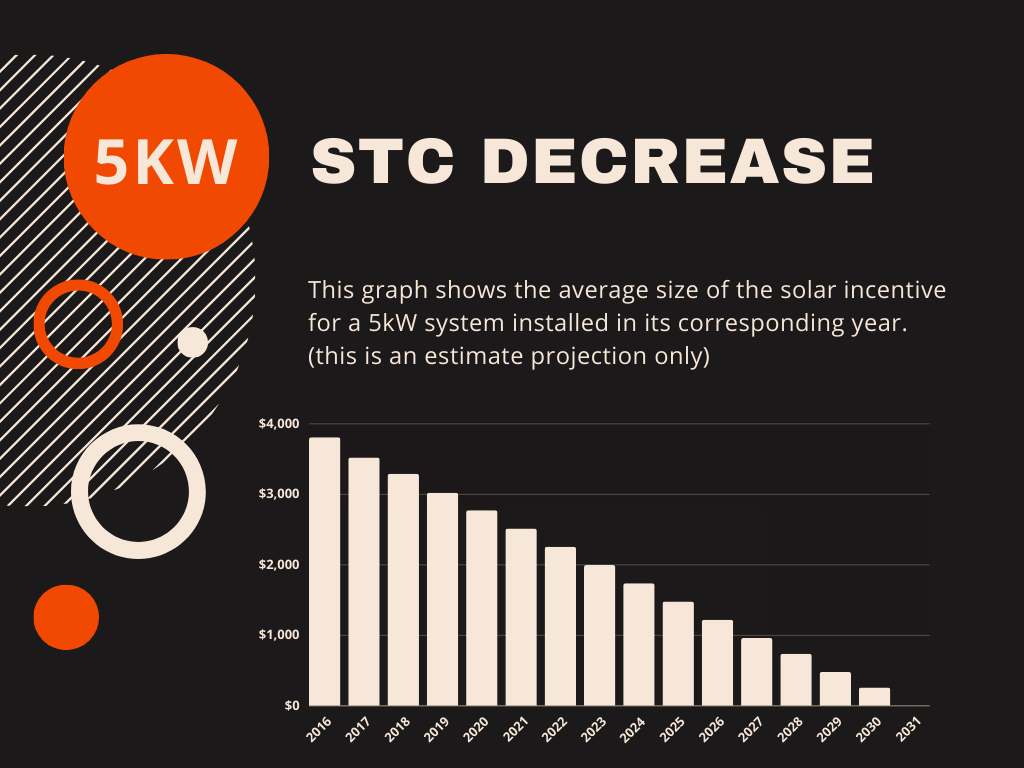
Because of this – you see many solar retailers on late night TV screaming at you to “quickly buy before the rebates run out!”.
The funny thing is, those STCs are created after your system has been installed so it’s very likely that the advertising you’re seeing is just a marketing tactic and nothing less.
Does that mean I’m paying more if I wait till the following year? Well, yes.. and no. The manufacturing cost of inverters and panels is continually reducing. Whilst yes technically you are not receiving the same discount, system prices have stayed around the same amount for the last few years regardless.
The second discount you will hear about if you are in Victoria is the SolarVic Panel Rebate. This is a true rebate of $1400 which comes off the price of you solar system at the time of sale and is then claimed by your solar retailer. More information about the SolarVIC rebate can be found here.
What is a feed in tariff / credit?
You reduce your cost or make money with a solar system in two ways. Firstly, any energy that house is using will be offset by what you’re generating during the day. Secondly, any excess energy your home is not using will be fed back to the energy grid and you will receive a credit back on your energy bill.
These credits range depending on energy plans, location and rules set by your distributor. At the time of writing sit between 4c and 12c per kWh.
Why do I hear about friends getting unexpected costs?
This is a big one, and a huge reason it’s really pays to choose the right retailer. It’s extremely important to ensure that everything has been factored into your quote when you receive it. Nobody likes unexpected costs so here are a few tricks to ensuring that everything works out on the day. Watch out for some of these below:
- Make sure you choose a retailer which has asked for a photo of your switchboard and meter (and supply it when they ask!).
- Request a site visit.
- You have a non-standard roof pitch – let the retailer know.
- There is no access from ground level to the first story, then access to the second story.
- A significant distance exists between where you want your inverter and where the switchboard/meter is.
- Your switchboard is internal.
The reality is that the installation process is a trade, like arranging a plumber or the installation of an air conditioner – sometimes things might seem simple on the surface but you’ll never really know if there are complications until someone is there on site to confirm. Choose a retailer which is thorough, asks lots of questions and understand your own personal circumstances.
Quality vs. Cost: Striking the Right Balance
While it’s tempting to opt for the cheapest option available, quality is the last thing that should be compromised. Cheap systems might offer long warranties but servicing those warranties can sometimes take longer. Less expensive options might sacrifice reliability, or efficiency and if there is one industry the following saying should be most prevalent in, its: ‘the poor man pays twice’.
Investing in a premium system upfront and getting higher-quality components (panels and inverter) will save significant headaches and expenses in the long run.
We only use the highest quality hardware available on the Australian market. This starts with the inverter which is the most likely component to fail but also extends to the smaller components like DC cabling, racking and the mounts used to attach the panels to your roof.
Warranties and Support
Understanding the warranties and after-sales support is paramount. A reputable retailer will offer warranties on both equipment and installation. Ensure you comprehend the terms, coverage, and duration of these warranties. Equally important is their customer support—know how responsive they are to queries or issues post-installation.
Some warranties cover parts and labour. Some only cover the parts. Do your research and don’t take a salesman’s word for it.
Local Regulations and Permits + Solar for Heritage Houses
Navigating local regulations, permits, and paperwork can be daunting. A reliable retailer should guide you through this process, ensuring all necessary permits and approvals are obtained. Compliance with local standards and regulations is crucial to avoid potential fines or legal issues in the future.
If you’re in an area with heritage housing in Australia it will pay to look into what rules and regulations are in place. This can be in the form of a phone to your local council. In some cases, permits will need to applied for and supplied.
Some states require an independent inspector to assess the work that has been completed to ensure that it meets certain standards. They then issue a certificate of electrical safety. In New South Wales however this is typically issued by the licensed installer who completes the job at your property.
Energy Storage Options
While solar panels generate energy during the day, storing excess energy for nighttime use might be beneficial. Ensure you understand the difference between Explore options for energy storage systems like batteries. Assess the feasibility and cost-effectiveness of integrating storage into your solar setup.
System Monitoring and Maintenance
Knowing how your system performs and identifying issues early is vital. Retailers, Inverters and Batteries typically offer monitoring systems allow you to track your energy production and system health though in some cases this feature does not come as standard. Inquire about maintenance requirements and whether regular checks or maintenance services will be completed on your system.
Environmental Impact
Apart from the financial benefits, consider the environmental impact of your solar installation. Choosing cleaner energy sources contributes to reducing your carbon footprint and supports sustainability efforts.
Payment Options and Financing
Understanding payment options and financing schemes is essential. Some retailers offer flexible payment plans or financing options to make solar installations more accessible and lower the barrier of entry however you will typically spend more if you opt for this route. Unfortunately, nothing in this world is ‘free’ and least of all the option to borrow money.
Retailers offering ‘Interest Free’ Options are typically absorbing the interest within the price of their system – meaning you are paying the interest whether you like it or not (and these figures are around +20%). Alternative options include ‘low-rate green loans’ and fixed rate interest baring loans. These loans have an interest rate which you pay – however you can usually pay off these loans sooner meaning that you pay less interest overall.
Evaluate these options to find the most suitable arrangement for your financial situation.
Comparing Multiple Quotes
Don’t settle for the first quote you receive. Compare quotes from multiple retailers, considering not only the price but also the components, warranties, and the level of service offered. A common mistake that is made when reviewing different quotes is not understanding that there can be thousands of dollars difference when it comes to the cheaper hardware over the more premium and reliable hardware options.
This comparison ensures you make an informed decision based on multiple factors.
Educate Yourself
Finally, empower yourself with knowledge. Educate yourself about solar energy, system components, how they work, and their benefits. The more you know, the better equipped you’ll be to ask the right questions and make informed choices.
You can find additional articles on products and guides on how a system works by accessing the links up the top. Or clicking the following: